 |
| From: http://edcetera.rafter.com/tag/trends/ |
Lisa Nielsen’s blog is all about incorporating technology in
the classroom to help student development. After reviewing her blog posts, I’m
torn - on one side, I see the incorporation of technology within my own
disciplines, English and History, as being a great advantage to have in the
classroom, but on the other side, there can be quite a bit of negative
repercussions to technology and teaching. While the digitalization of information makes information more accessible,
the value of the information is lost
to sheer amount of data available. There is something much more stupendous about
having a physical book in one’s hands rather than staring at an impenetrable screen.
Neilsen's recent post, found here, discusses how Google docs can
improve student writing. She highlights a few neat features which Google docs
provides their users:
- First, the Voice to Text feature which converts whatever is written into an automated voice is really helpful in catching grammar and syntax mistakes because it allows you to listen to your work and adjust awkward sounding sentences. This is definitely a 21st century technological feature I would my encourage my students to use.
- Second, the translate option in Google docs. My experience with any translating program is that they are pretty awful. I’m quite skeptical about the use of translating programs in the classroom because they offer an easy way out of doing work, and on top of that, they barely work.
- Lastly, the Research option in Google docs allows users to easily cite their information in MLA, APA or Chicago formats. But slow down! Having a program create citations for students is really convenient and demonstrates 21st technological literacy, but at the same time, by making a program do all the work, do students really learn anything? Not to mention, half the times, these citation websites are produce erroneous work.
After reading some more of Nielsen’s post on tech and
classroom stuff, here’s some of my opinions on the role of technology
specifically in English and history. As a disclaimer, I’m definitely more of a
traditionalist when it comes to technology, but that doesn’t mean that I can’t
incorporate 21st century literacies within the classroom:
Laptops make writing easier, no doubt. However, they also
are a gateway to a ton of distractions: social media, youtube, online games etc.. Even if laptops make writing easier, one major problem is that all word processing software autocorrects misspelled words. Student’s don’t have to know the spelling of
words anymore because technology does it for them.
Moreover, a more serious problem is that students don’t need
to know words at all. Why bother learning the definitions and contexts of
words, when there are giant online dictionaries and thesauruses that contain
every single world imaginable. Personally, my vocabulary stinks because
whenever I don’t know a word, I Google a word similar to it, in order to find
it. There is very little need for retention anymore. Technology makes memorizing useless.
At the same time, Google and the internet in general makes
research way more easier to do. The internet has pretty much everything you
will ever need to write an English or history paper. That being said, its up to the student to know how to properly gather information to write papers effectively. On the contrary, the teacher's task is to provide the tools for students to properly use the internet for research. Back in my previous post, I mentioned teaching my students research skills, such as using search engines and databases. In addition to teaching students contemporary research methods, I also believe dedicating some lessons to the actual software they use to to write is important for the incorporation 21st century literacies. Word processing programs are becoming increasingly more powerful in their ability to create and manufacture texts. Technological literacy for me means an ability to use these programs to their fullest potential in order to produce the best work possible. However, I wonder if there is a real purpose of teaching students how to use word-processing programs, if all the essays they are expected to hand it, follow the exact same uncreative format. If we really want to teach critical literacy, we should loosen up on conventions in order for students to take full advantage of the technology that surrounds our everyday. This doesn't imply to throw away convention totally, but to its a call to stop being to limiting, because in turn, a limited mindset only hurts students' inventiveness.
 |
| From: techcrunch.com |
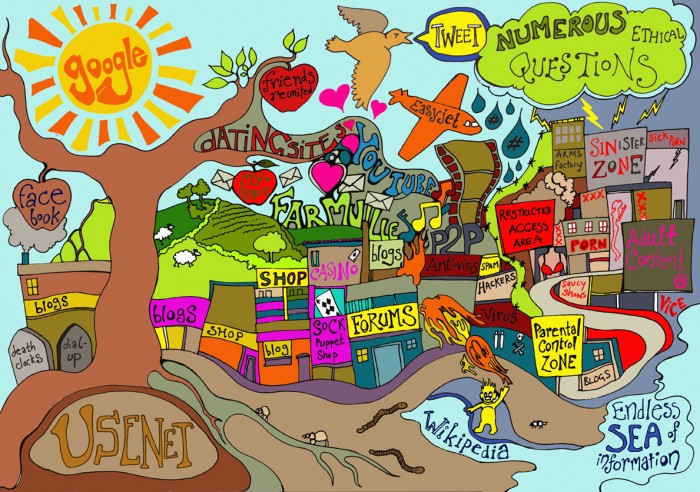
The incorporation of technological literacies within English
and history has to be in a harmonious balance. While the internet is an amazing
tool, there are many drawbacks to it. In my classroom, I want to teach students
both traditional (ie. going to the library and knowing how to find a book) and
contemporary (ie. going on the internet and knowing how to find an article) research
methods. Although not encouraged for their distractive qualities, laptops and internet would be allowed in my classroom.

No comments:
Post a Comment