Friday, 25 March 2016

Incorporating Literacies Part 2


From: http://edcetera.rafter.com/tag/trends/

Lisa Nielsen’s blog is all about incorporating technology in the classroom to help student development. After reviewing her blog posts, I’m torn - on one side, I see the incorporation of technology within my own disciplines, English and History, as being a great advantage to have in the classroom, but on the other side, there can be quite a bit of negative repercussions to technology and teaching. While the digitalization of information makes information more accessible, the value of the information is lost to sheer amount of data available. There is something much more stupendous about having a physical book in one’s hands rather than staring at an impenetrable screen.       

Neilsen's recent post, found here, discusses how Google docs can improve student writing. She highlights a few neat features which Google docs provides their users:
  • First, the Voice to Text feature which converts whatever is written into an automated voice is really helpful in catching grammar and syntax mistakes because it allows you to listen to your work and adjust awkward sounding sentences. This is definitely a 21st  century technological feature I would my encourage my students to use.
  • Second, the translate option in Google docs. My experience with any translating program is that they are pretty awful. I’m quite skeptical about the use of translating programs in the classroom because they offer an easy way out of doing work, and on top of that, they barely work.
  • Lastly, the Research option in Google docs allows users to easily cite their information in MLA, APA or Chicago formats. But slow down! Having a program create citations for students is really convenient  and demonstrates 21st technological literacy, but at the same time, by making a program do all the work, do students really learn anything? Not to mention, half the times, these citation websites are produce erroneous work.
After reading some more of Nielsen’s post on tech and classroom stuff, here’s some of my opinions on the role of technology specifically in English and history. As a disclaimer, I’m definitely more of a traditionalist when it comes to technology, but that doesn’t mean that I can’t incorporate 21st century literacies within the classroom:

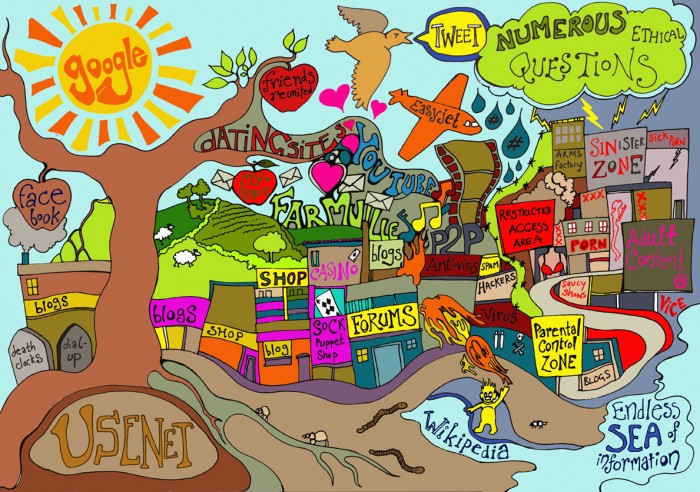
Laptops make writing easier, no doubt. However, they also are a gateway to a ton of distractions: social media, youtube, online games etc.. Even if laptops make writing easier, one major problem is that all word processing software autocorrects misspelled words. Student’s don’t have to know the spelling of words anymore because technology does it for them.

Moreover, a more serious problem is that students don’t need to know words at all. Why bother learning the definitions and contexts of words, when there are giant online dictionaries and thesauruses that contain every single world imaginable. Personally, my vocabulary stinks because whenever I don’t know a word, I Google a word similar to it, in order to find it. There is very little need for retention anymore. Technology makes memorizing useless.

At the same time, Google and the internet in general makes research way more easier to do. The internet has pretty much everything you will ever need to write an English or history paper. That being said, its up to the student to know how to properly gather information to write papers effectively. On the contrary, the teacher's task is to provide the tools for students to properly use the internet for research. Back in my previous post, I mentioned teaching my students research skills, such as using search engines and databases. In addition to teaching students contemporary research methods, I also believe dedicating some lessons to the actual software they use to to write is important for the incorporation 21st century literacies. Word processing programs are becoming increasingly more powerful in their ability to create and manufacture texts. Technological literacy for me means an ability to use these programs to their fullest potential in order to produce the best work possible. However, I wonder if there is a real purpose of teaching students how to use word-processing programs, if all the essays they are expected to hand it, follow the exact same uncreative format. If we really want to teach critical literacy, we should loosen up on conventions in order for students to take full advantage of the technology that surrounds our everyday. This doesn't imply to throw away convention totally, but to its a call to stop being to limiting, because in turn, a limited mindset only hurts students' inventiveness.
From: techcrunch.com

The incorporation of technological literacies within English and history has to be in a harmonious balance. While the internet is an amazing tool, there are many drawbacks to it. In my classroom, I want to teach students both traditional (ie. going to the library and knowing how to find a book) and contemporary (ie. going on the internet and knowing how to find an article) research methods. Although not encouraged for their distractive qualities, laptops and internet would be allowed in my classroom.


At the end of the day, the main concern for the incorporating the literacies is to have critical students who question their surroundings. If students prefer the use of laptops, I want them to be aware of the pros and cons that they may face. If a student is 'taught' to be critical, they can figure out what works best for them.

Thursday, 17 March 2016

Cont. Part 1

In his second post part of three part series dealing with technology and the classroom, Gorman provides a list of websites for teachers to use as resources to help them teach their students reading skills. One of my favourite websites is Simple English Wikipedia which translates Wikipedia articles into ‘simple’ English that can be easily grasped by younger students and adults alike.

After reviewing the website, however, I wonder if it incorporates the ‘spirit’ of the literacies. On one hand, it makes information more accessible by providing articles in an easy to follow format. On the other hand, this easy to follow format comes at the cost of quite a bit of valuable information which is taken out in order for the article to read easier. The ‘critical’ aspect of Wikipedia articles are eliminated on this site; reducing them to a set of historical facts.

As a future teacher, I’m split on whether to incorporate this website as a resource for my students. Aside from Simple English Wikipedia, this discussion raises the broader question about using Wikipedia as an accepted resource within the classroom.

 From: http://www.slideshare.net/jasonhoradam/using-pb-works-in-the-classroom


Pretty much everybody already uses Wikipedia, however when I was in school, we were told never to cite it because the facts were not validated. Recently, I’ve heard that Wikipedia has endeavoured to legitimize their citations. Nevertheless, rather than using Wikipedia as a resource,  which in itself is demonstrates a type of technological literacy, I plan to teach my students how to properly use search engines and databases. By dedicating a few lessons to teaching students how to use search engines, I give them the ‘conceptual’ tools for fostering their development of all the literacies. Search engines and databases allow students to explore diverse fields on knowledge, in turn promoting their capacity to access information pertaining to the literacies.

***

Rather than finishing up Gorman’s series, I wanted to move to a more recent post of his in which he discusses Sugata Mitra, a leading educational scientist, whose research advocates the simple, but powerful message: participation is preparation. Gorman discusses how the modern educational paradigm assumes that learners need to be prepared before they can participate, and that preparation is based on learners following a plan, and for teachers to measure the outcomes of that plan.

I liked reading Sugata Mitra’s mantra because it seems like the model I want to base my classroom off of. Participation is the vehicle in which all the literacies are expressed. If students are not given the chance to participate, or feel uncomfortable participating, the incorporation of the literacies is futile. Without students have the ability to voice their opinions, the literacies are reduced to empirical categories of knowledge which hold no significance. It is through student voice that the literacies take on an intrinsic value.  

Sugata Mitra discussing self-teaching 

Image result for circle classroom arrangement
From: http://twbonline.pbworks.com
In my discipline, English, I believe fostering participation starts with the classroom layout. No one wants to sit in individually because it feels isolating and unfriendly. I envision my classroom as a gigantic circle, with my desk included, or as a round table. The spatial arrangement of the room always sets the tone. Having an inviting, and open space, provides the basis for a democratic classroom, which translates into a seamless incorporation of the literacies.

Discussion and participation are the main vehicles for the literacies to be taught. One practice that I enjoyed as a student was having mock debates about issues because it developed my critical literacy by looking for the shortcomings in my peers arguments, and it also gave me an appreciation for my classmates opinions. Mock debates is a great way to incorporate the literacies because it provides a democratic avenue for participation, while also giving rise to new insights. Debates about financial decisions, multiculturalism, and environmentalism would be interesting to watch unfold in the classroom! 

Wednesday, 16 March 2016

Incorporating Literacies Part 1


From: http://www.baas.ac.uk/usso/category/skills-development/teaching-skills-development/


/
Michael Gorman is a prominent blogger who regularly posts on transforming role of technology in the classroom. He is partnered with ISTE and various educational, governmental, and business organizations and foundations. Click here to go to his blog!

What captured my attention on his blog was his three part series on technology and education. Particularly, Gorman discusses Tech Resources and Tools for Differentiated Learning for Reading.
In his first post in the series, he describes his experiences in a Project Based learning (PBL) classroom incorporating differentiated instruction for reading. Although the description is fairly short, he goes onto recommend a few of his favourite reading resources (some of my top picks found below) to share with students, which cover a diverse range of reading levels. One common theme that runs throughout all of his recommendations is that they all contain current events and news.

Breaking News - a cool website, dealing with popculture news that allows you to sort articles by reading levels.
Newsela - easy to understand content which looks at current events.
Commonlit - a free digital collection of fiction and nonfiction for the classroom, appropriate for all age levels. 

As a future English teacher, I never gave much thought to what I would actually assign my students to read. Back in highschool, I remember reading mostly Shakespeare and an assortment of classical novels, but we really never paid any attention to the current world events, at least not in English.

I like the idea of getting my students to read current events because it’s an effective way to implement the literacies within the classroom while also fitting neatly into the curriculum. For instance, if I were teaching students journalistic writing, we could examine newspaper articles which, in themselves, deal with a myriad of topics that incorporate the literacies, i.e. articles about environmentalism, multiculturalism, global relations are all reflective of the literacies.

That being said, there seems to be a dilemma about what actually constitutes the incorporation of the literacies. To elucidate, if I give my class an article dealing with  a particular issue, say the Syrian refugee crisis, does exposing them to this contemporary issue signify that I have incorporated multicultural and global literacies into the classroom?

I think incorporating the literacies requires a bit more ‘unpacking’ than simply getting students to read current events. However, how does one ‘unpack’ the literacies in the classroom? How does the teacher ‘teach’ the literacies? Going back to the example of getting students to read an article about the Syrian refugee crisis, just because students have read it, doesn’t mean that they ‘understand it’, nor the literacies which article incorporates.

Is it the job of the teacher to unpack, to ‘explain’ the article, and by extension the literacies? If so, there are a few problems to this approach:

  • Firstly, if the teacher unpacks/explains the article and the literacies contained within it, they position themselves as the explicit authoritative figure.  Although there is nothing wrong with the teacher taking an authoritative role, it has the potential to marginalize student voices and opinions, by propagating the teacher’s view as the ‘correct’ view. Consequently, the teacher becomes the dictator of the class whose totalizing power forecloses the possibility of other voices. One way to combat this quasi-dictatorship role as a teacher is to constantly ask questions and involve your students in the teaching process.
  • Secondly, there is the question of ideology. What I mean by this is that the teacher, in the process of teaching, will always express their subjective views. The problem being is that these subjective views once again have potential to silence student voices. For example, a teacher raised in an affluent community, teaching in a lower SES neighbourhood will have a different Weltanschauung (world perception), and by processes of cultural hegemony, the teacher’s world view will function as the authoritative worldview within the classroom, which in turn causes the students to conform to this world view in order to adhere to the authority of the
    teacher. Pierre Bourdieu’s book, Distinction is really good at explaining the above in detail.
  • Lastly, I return to the problem of constitution. All the literacies are clouded with multiple definitions. Accordingly, what definition is the ‘right’  definition or what definition does the teacher use as a point of departure?

From: uvufacultycenter.blogspot.com

In order to incorporate the literacies effectively, I believe the teacher has to act as a sherpa, guiding students to the summit, by giving them the conceptual tools to reach the top. By  minimizing their symbolic authorial position, teachers foster a space for student voice and involvement. The democratization of the classroom is needed for the incorporation of the literacies, otherwise, any attempt at ‘teaching’ the literacies will end up in expressing the subjectivity of the teacher which residues rub off onto the student, influencing their perception.

The idealistic goal of education is to create democratic, ethical citizens who contribute to society. The broad range of information which the literacies cover, from environmentalism to financial knowledge, prepare students for democratic involvement. But this democratic involvement starts with the teacher democratizing the classroom.

As a future teacher, creating a democratic environment to allow for the incorporation of the literacies is my top priority. By creating an open, collaborative space in which student voices can be freely articulated, I hope to foster students’ critical literacy skills, providing the developmental basis for the other literacies.